Oneida Nation hosts Fifth Convening Culture Keepers
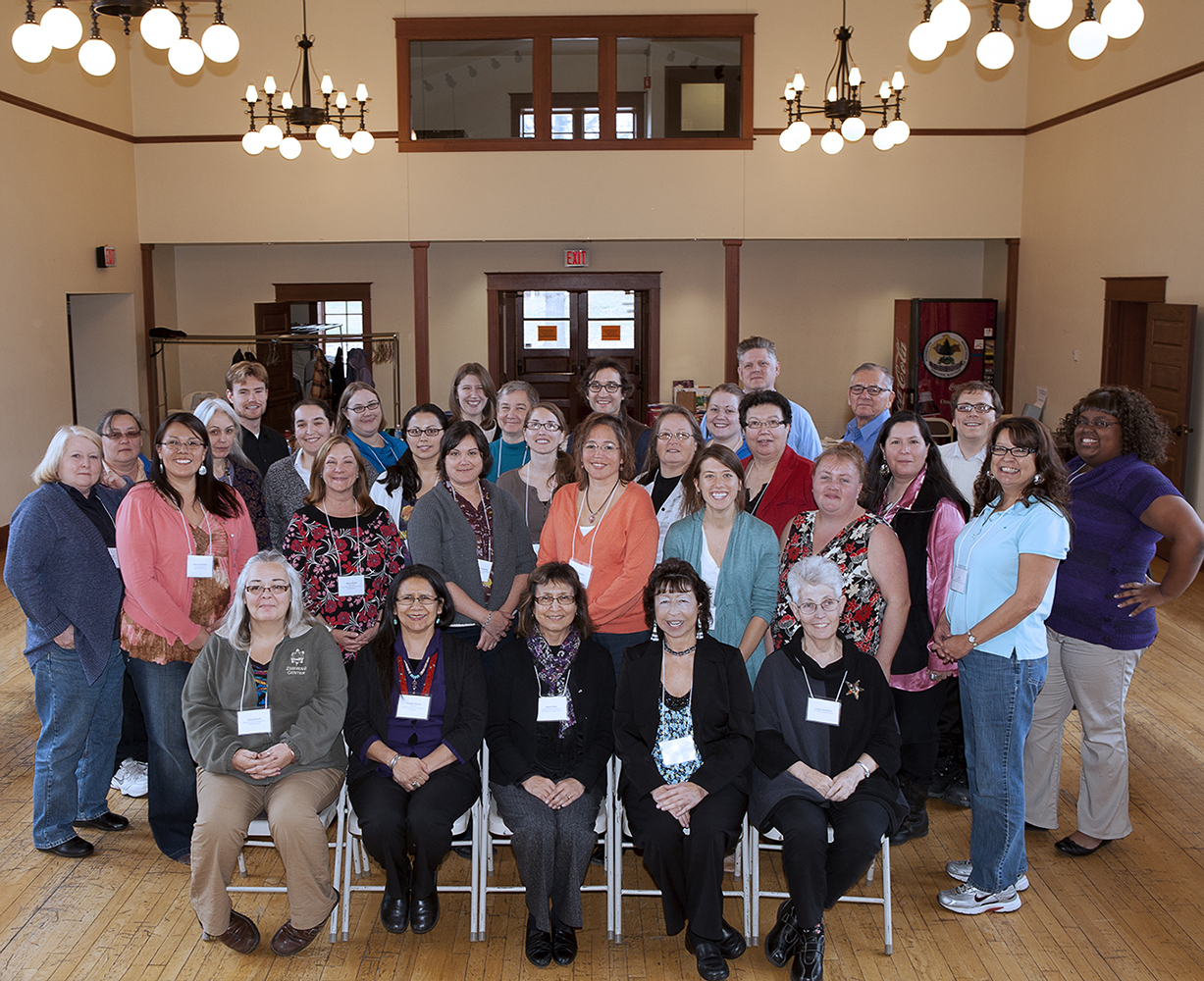
CCK5 Group Photo
Attendees of the fifth Convening Culture Keepers at Oneida, Wisconsin

On November 8 and 9,  over thirty Wisconsin tribal librarians, archivists, and museum curators at the fifth gathering of Convening Culture Keepers (CCK) hosted by the Oneida Nation.  Eleven SLIS faculty, staff, and students helped organize and attended the event.

Louise asks a little community member a question

Louise asks a little community member a question at the library

The gathering began on Thursday afternoon, with tours of the Oneida Museum, the Oneida Community Library, and Cultural Heritage’s restored log homes.

That evening, the Longhouse provided a delicious traditional meal of squash, beans, corn, venison, and bison, with strawberry drink and dessert.  The dinner was followed by a social dance led by the Oneida Longhouse Singers.

Social Dance

Culture Keepers, LIS students, and Longhouse dancers enjoy the social.

On Friday, Culture Keepers sat in on four professional development sessions.  Shannon Martin (Ojibwe) spoke about the process of designing and maintaining the award-winning Ziibiwing Center of Anishinabe Culture and Lifeways, of which she is director.

Her talk, “Building a Community-Driven and Participatory Tribal Museum” was an inspiration to those in the process of building new institutions, like the Red Cliff Band of Lake Superior Chippewa with plans for their new community space.

Debbie Reese (Nambe), author of the blog American Indian’s in Children’s Literature, taught Culture Keepers how to evaluate children’s books in her presentation “The Role of Children’s Books in Native Nation Building”.

Culture Keepers at Parish Hall

Culture Keepers at Parish Hall

Culture Keepers learned about how to create traveling museum exhibits and tours from Mary Olson, a freelance exhibit developer.  She had previously worked with the Arvid E. Miller Library and Museum of the Stockbridge-Munsee Community.

Janice Kowemy (Laguna), president of the American Indian Library Association and director of Laguna Public Library in Laguna Pueblo, New Mexico, spoke about tribal library advocacy.  Her expertise provided Culture Keepers with ideas on promoting their own institutions to their communities and beyond.

Omar, our Presenters, and Rita pose for a picture

The conference planner, host, and speakers pose for a picture: Omar Poler, Shannon Martin, Rita Lara, Debbie Reese, Janice Kowemy, and Mary Olson

Many participants noted that they are excited about future gatherings.  The sixth gathering will be hosted by Lac Du Flambeau in Spring 2012.

Tune in next week for a reflection by SLIS student Mary Wise on her experience at Convening Culture Keepers!

For more information about our fifth Convening Culture Keepers, including the agenda and presenter materials, follow this link.

Indigenous Epistemology. What’s that you ask? – TLAM Week 4

Indigenous Epistemology. What’s that you ask?

This week in class we spent a 2 hour and 30 minute session going over just this. There is no short answer in sight, but rather an overview of the engaging discussion that my classmates and I experienced through the insight of guest lecturer Ryan Comfort from the American Indian Curriculum Services, School of Education.  As he began his presentation, it became apparent that it would be theme based, integrative, and interactive. The skillful address of the number four as the main theme connected everyday life with the epistemology if indigenous practice.  We did four exercises, related those exercises to four elements, and explored the hidden connection that this concept of four has to our everyday lives.

The first exercise required each individual to channel a raw and unexposed part of their inner connection to a place or thing and further express this connection in the format of an ‘I Am’ poem. The poem was not limited to a scheme or a meter preference, but rather to a channeling of the senses. It went something like this:

I am the mist on a brisk autumn day
I am the sunshine peeking through the fray
I am the crisp scent of morning after a wee rain storm
I am the craggy rock beneath your feet after the dew is gone
I am the dampness on your cheeks and the salt from your tears
I am the last harvest of heather, home of the Scottish hills.

My motives for sharing this poem do not stem from vanity, but rather to express a key element of Ryan’s presentation. “Think, pair, share.” All of the exercises that we engaged in held this requirement, which was both beneficial and at times uncomfortable.

Now for the unveiling of the magic number four. Ladies and gentleman I present to you the medicine wheel!

The attributes of beliefs, values, the physical, and mental are all embodied through the medicine wheel to demonstrate the importance of connection. With the progression of Ryan’s exercises, it became clear that he was aiming to demonstrate this connection through the focused intent behind each activity. For example, where the second exercise focused on listing what we individually knew about Native Americans and where we got this information, the third exercise forced us to discern if our information came from a credible source. Of course, then the question became, what is a credible source? But this is yet another example of something that cannot be answered in a generic way as it differs greatly with each discipline.

Now we move forward to yet another connection that Ryan wove into his presentation. Being that he was catering to an audience of library school graduate students, he modified his last and fourth exercise to fit nicely with the other requirements of the TLAM course. Through this exercise, we were asked to brainstorm on ways the process of learning about indigenous culture could be incorporated in the public library setting. Sounds like an easy task, but it was full of unexpected challenges. Concerns about budget, appropriateness, receptiveness from the respective population the library serves, and accuracy of information all warred for dominance. Thankfully, this was not an answer that we needed to have that same day. However, it is an exercise that I feel Ryan hoped we would carry with us during our journey as library, archive, and possibly museum professionals.

By: Sarah Morris

Week 4: 2/10/11

History, Media, and Stories – TLAM Week 3

For the third week of TLAM, we looked at the topics of Wisconsin tribal histories, media, and storytelling. Class began with a continuation of the discussion from the panel at last week’s screening of “Reel Injun.” Like the panelists, many of us were concerned with the issue of how to present depictions of Native Americans in Hollywood movies and TV to children in a way that can create a positive learning experience. We liked that the documentary ended on a positive note by showing that more Native actors and filmmakers were beginning to tell their own stories, using media as a positive force. This discussion provided a good set-up for our guest of the week, Patty Loew, whose book Indian Nations of Wisconsin we had just finished reading.

Patty had just recently returned from a trip to Mozambique, where she been helping to train community-based journalists. She made an insightful parallel between Native American cultures and the people of Mozambique regarding challenges they face not only in acquiring and transmitting information because of the widening digital divide, but also in how to educate the next generation in traditional culture.

For the rest of the class we learned about how the Tribal Youth Media camp at Lac Courte Orielles, which Patty helped to create, helps Ojibwe children learn about science in ways that integrates with their culture’s traditional methods of learning. A major problem that Patty sees is the tremendous disconnect between Native children and the field of science, partly due to the fact that the way science is taught in ways that aren’t compatible with traditional Native American culture and worldviews. The lack of Native people with a scientific background is especially problematic because today there is a great need for tribes to have scientists that can help them protect their natural resources. At the camp Patty told us about, Native culture leads science, including ethics and values with the other information the kids learned.

The Tribal Youth Media program linked well to the chapter from Donald Lee Fixico’s The American Indian Mind in a Linear World that we read for class this week. Fixico explains the important role of oral tradition and traditional knowledge in teaching Native American history and culture. Storytelling conveys “values, ideas, beliefs [and] insights about the community,” and also serves a relational purpose, connecting people and places. I could easily see how this idea of storytelling and traditional knowledge was integrated into the experience of the science camp at LCO.

Finally, the class went to the Tribal Youth Media website where we watched one of the videos created by the kids, which incorporated both scientific research and interviews with tribal elders. They did an amazing job! Thanks again to Patty Loew for sharing this with us.

- Kelly

Nancy Mithlo and Tom Jones 3/27/09 Tribal Museums

This week we had speakers Nancy Mithlo and Tom Jones discuss their experiences and professional work with museums. Nancy’s background is in anthropology and she has studied and worked all over the country. She spoke about Native American art and museums in relation to education and awareness. She described to us her experiences with the National Museum of the American Indian, her impressions and the controversy surrounding

Nancy Mithlo, a professor with the American Indian Studies program and Art History Department at UW-Madison.

Nancy Mithlo, a professor with the American Indian Studies program and Art History Department at UW-Madison.

the museum. Also, she spoke of Native American imagery and we viewed a short film by Erica Lord entitled “Redman” that depicts the brutality of racism through rather simple, but stark imagery and dialouge. Nancy also mentioned her new book Our Indian Princess which discusses imagery as communication, issues surrounding causation of racial stereotypes, and how imagery can form the framework for discussion of Native American issues. She gave the names of  many artists, intellectuals, books and concpets- below are some links to topics mentioned in the lecture and during lunch following the talk.

Links
Institute of American Indian Arts

The National Museum of the American Indian: Critical Conversations

Andrea Smith, author of Conquest

Fred Wilson, artist

Kevin Grover apology from the BIA

excerpt from “Box of Treasures” short film made by the Kwakiut’l people of Alert Bay, British Columbia

Amy Lonetree, Assistant Professor of American Studies, University of California, Santa Cruz

Poeh Center

Roxanne Swentzell, artist

Native American Studies Association

Aboriginal Curatorial Collective

The Forward Foundation
Institute of Museum and Library Services, Grants Applicants, contact Alison Freese

more information about the Native American Video Tape Collection, 1976-Pres.

Tom showed us his work and discussed his various projects, (link above). He also shared with us his experience as an artist featured in the opening of the National Museum of the American Indian. Two collections that he shared

Tom Jones, professor in the Art Department at UW-Madison.

Tom Jones, professor in the Art Department at UW-Madison.

with us were “Encountering Cultures” and “‘Native’ Commondity.” These two collections are an example of the range of Tom’s interest and the depth of his work.

This was an inspiring presentation by both Nancy and Tom that stimulated much thought and discussion within the group. Their expertise and willingness to share experience and knowledge was greatly appreciated.

10/26/09 Curriculum Meeting

This is just to cover a few things we discussed at the curriculum meeting. First we discussed why TLAM should be made into a class, some major points were: enrichment for SLIS, it reaches out to other students, not only SLIS students but undergrads and students from other disciplines, it also connects SLIS with communities beyond Madison. TLAM could also be a class to educate future librarians on the fundamentals of ACT 31. We also discussed the future of the class. There are so many directions that we could go in, but it seems that perhaps hosting a conference, may be the next step in the outreach process. Also discussed were the implications and possible purposes of the bibliography. What is most certainly gleaned from this project so far, is the uniqueness of the course and the interest that it has spurned in tribal libraries and other community institutions.

U. Club Luncheon

Today was an interesting class in that we all met at the University Club. We were joined by Ryan Comfort (Recruitment & Retention Specialist [Student Diversity Programs]) and his assistant Aaron Bird-Bear, Tracy Peterson (American Indian Student Academic Services), and Janice Rice (former AILA president and pretty much Jedi-master in the art of the Native library).

Ryan was very interested in the bibliography we are compiling for TLAM, as he is attempting to do something similar himself. (He mentioned a collaboration on the bibliography should be in order and then he would publish the result, or at least make it available to those interested.) Overall, Ryan seemed very excited about having a “community/student organization like TLAM” because he could envision a relationship into the future–especially since a mojority of the class will be returning students next year. (It is worth noting, too, that Mr. Comfort expressed to Omar and I that he will be contacting professors at SLIS about TLAM to find out who may want to get involved in the future.)

Ryan & Tracy just returned from a visit to Potawatomi’s museum. (Incidentally, Ryan and Tracy are undertaking visiting all the tribes [several times] in WI to open communications and encourage tribes to consider artifacts that would be representative of their tribes for a project.) Although Tracy doesn’t have formal background in librarianship, he has worked on a native library project for Cornell (I believe he cited a library which no longer exists in Brooklyn?) in which he acted as a Native representative.

Tracy is, essentially, a person who knows many people–if TLAM is looking to track down people in a certain area or field in the future, then Tracy could be an asset.

It also came to our attention, thanks to Janice, that Tracy and Ryan brought gifts of tobacco to the Potawatomie’s–and was much appreciated by the elders. This brings up the question: Do we need to do something of this nature for our own TLAM trips–or would this be inappropriate? Obviously, a gift of some sort would be something to consider for their time.

Misc.: Janice mentioned today in her talk that as a child in Tomah, Inidans did not have interaction with the library. In fact, her mother would drop her off and wait for her in the parking lot while she went in. (Outside Tomah, Janice also cited a library where native children were more or less banned from the library.) It wasn’t until Janice hit undergraduate at LaCrosse and Eau Claire that she discovered the amazing resources of a library. Janice took some library classes in undergrad. but majored in Ed. Eventually, she was hired as a youth services outreach consultant for a number of the small native populations in northern WI. (Subsequently, Janice went on to get two Library masters ans serve as AILA president and now works as the Native American collection manager at College Library.)

As she alluded to in her presentation, it was in her role as a consultant for the library that she began to realize how the library was non-existent to her as a child; but then, as a student and adult, she could see how she wanted to bring the library to others in the Native American community. This realization launched her native-focused librarian career, really–as well as that of other formative figures like Loriene Roy and Lotsee Patterson.

-In Janice’s words: “Many up in Indian country don’t respond to e-mail; the phone or in-person is what they respond to.”

-Eric

Reflection of Progress

First things first: I began this class knowing close to nothing on American Indian affairs–contemporary or otherwise–outside a handful of movies and some grossly inadequate public school history classes.

In reality, the classes served no other purpose than to gloss over a few hundred years of American governmental history–with little or no mention of the false premises by which the goverment secured millions of acres of native lands; the countless treaties broken therein; or the decimation of the Indian population due to white disease or outright murder. But, as I said, teachers had to fulfill their state-mandated lesson plans. (Also, Hollywood never provides any sort of authority on, well, anything so it should it come as no real surprise that Last of the Mohicans only propogates Cooper’s mis-nomer and the Native American as noble savage stereotype; if one scrap of redeemable anything can be salvaged then let it be said that Val Kilmer in Thunderheart at least made me aware of Indian sovereignty. )

But I digress.

Like others in the class, I took a leap of faith out into something new because I wanted to replace some admitted ignorance about Native Americans. (This happens when you grow up in a homogenous, white town.) Alyssa summed up quite neatly the thoroughness of Larry, Skott and Doug’s presentations so I will take a different angle.

The January 30th session represents to me the first time TLAM transformed from a set of amorphous, lofty goals into a real class. (It was, for the record, 4 hours long!)

January 30th was particularly powerful on two levels: first, Larry, Doug and Skott were all extremely knowledgable on treaties (dating from 18th to 20th century) and the state-of-affairs of what certain tribes around the country face today (Skott on the Utes and Arapajo, and Doug with the Oneida); second, on a purely emotional level, I felt the presentations even more powerful because they were in-person (not from a page), and each was articulate and engaging on their respective topic to the extent that it encouraged ME to want to engage on a subject I had heretofore felt too intimidated to talk about. (On a general level, I would like to believe these speakers are giving us some tools we can use–vocabulary and confidence–for the hands-on visits.)

In terms of how I see this class developing, I think Larry, Doug and Skott (and subsequent speakers) represent an essential part of the learning process of this class– we in TLAM must understand how the tribes in Wisconsin got to this point in their history–relocations, removal acts, termination, boarding school, allotment–if we are to be of any help to those in Red Cliff. Let me put it this way: the road to Hell is paved with good intentions; we may all have the best of intentions in mind, but we may do more harm than good in rushing up to Red Cliff without having a more informed grasp of what is going on.

Misc.: Doug brought up some provocative points, I thought, on how Indians are percieved as all being wealthy, due to the influx of $ in the last 20 years from gaming. Doug was quick to point out that while one might see some Cadillacs on the Oneida reservation, the generalization that all Indians are wealthy now is far from the truth. Actually, American Indians still rank at the bottom of most poverty categories. (And, even in Wisconsin, we know the existence of a casino does NOT necessarily guarantee wealth for a tribe or band, as is the case for some of the Ojibwe bands up north.)

The incorrect generalized-assumption of wealth and prosperity of Indians is interesting as a stand-alone concept, too. In the context that Indians are supposed to be a down-trodden, poverty-ridden people and culture, it is interesting to conceive of Indians as being monetarily “successful” or “doing well for themselves”. This raises the rhetorical question: What’s wrong with a successful Native American? I got the sense from Doug that this notion of perpetually being down-trodden needs to be challenged in order for a more positive picture to emerge.

According to my notes, we then segued into how $ on the Oneida reservation has not solved everything, as they face just as much political scandal and misappropriation of funds as regular government agencies. The existence of familial politics also makes it extremely difficult to implement long-term projects.

-Eric

Comments on American Indian Education: by Indians vesus for Indians

Obviously the history of the treatment of American Indians in the US is a painful reminder of the atrocities committed over the past 200+ years. This article I think does a good job of parsing out the good from the evil, giving description to the reality of Indian education. From this I ask, what is the next step? I would be interested to know what a reservation school would be like if there were no financial or social hindrances. What would be taught and what would be the fundamental differences between it and a traditional Anglo school?