Oneida Nation hosts Fifth Convening Culture Keepers
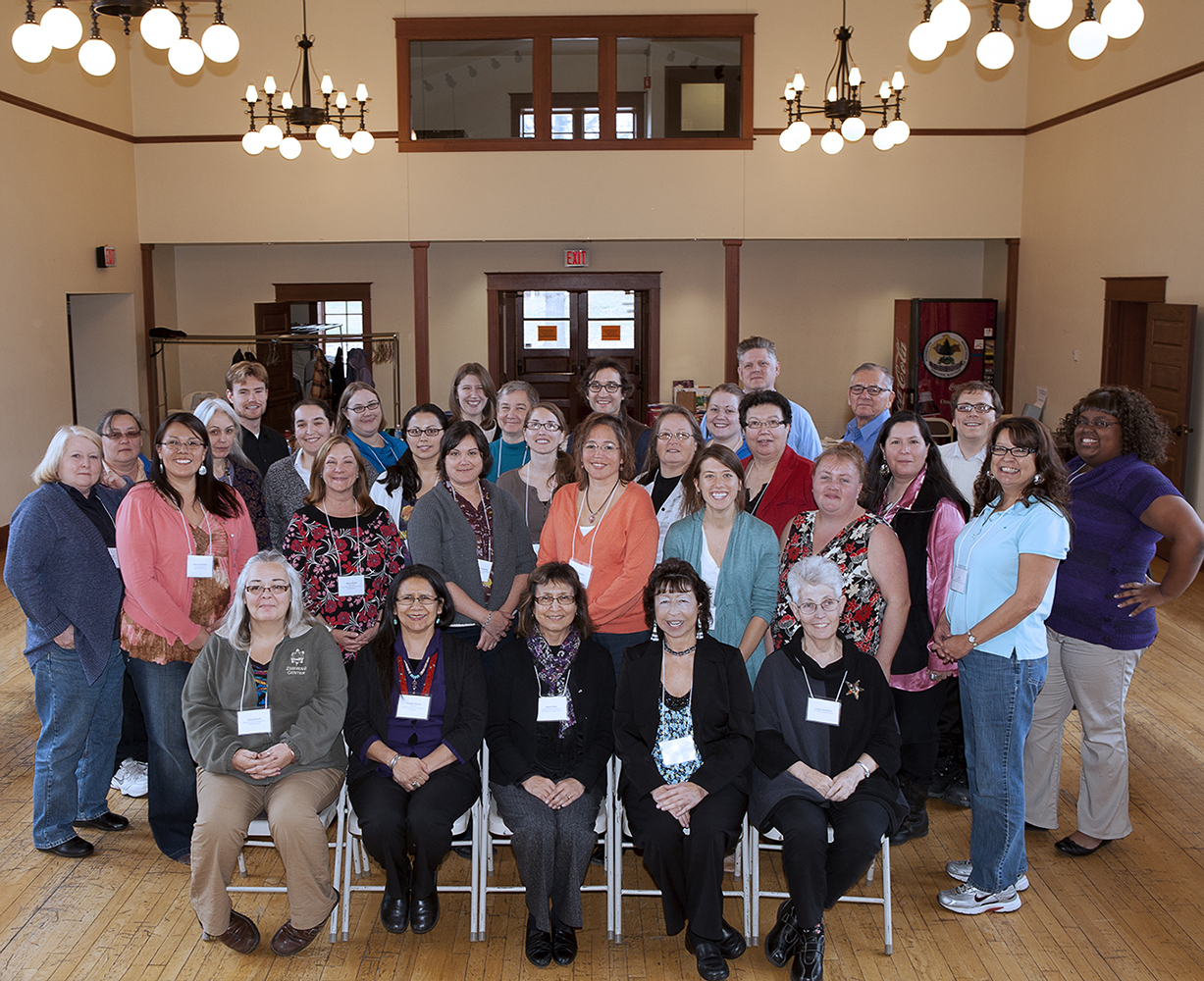
CCK5 Group Photo
Attendees of the fifth Convening Culture Keepers at Oneida, Wisconsin

On November 8 and 9,  over thirty Wisconsin tribal librarians, archivists, and museum curators at the fifth gathering of Convening Culture Keepers (CCK) hosted by the Oneida Nation.  Eleven SLIS faculty, staff, and students helped organize and attended the event.

Louise asks a little community member a question

Louise asks a little community member a question at the library

The gathering began on Thursday afternoon, with tours of the Oneida Museum, the Oneida Community Library, and Cultural Heritage’s restored log homes.

That evening, the Longhouse provided a delicious traditional meal of squash, beans, corn, venison, and bison, with strawberry drink and dessert.  The dinner was followed by a social dance led by the Oneida Longhouse Singers.

Social Dance

Culture Keepers, LIS students, and Longhouse dancers enjoy the social.

On Friday, Culture Keepers sat in on four professional development sessions.  Shannon Martin (Ojibwe) spoke about the process of designing and maintaining the award-winning Ziibiwing Center of Anishinabe Culture and Lifeways, of which she is director.

Her talk, “Building a Community-Driven and Participatory Tribal Museum” was an inspiration to those in the process of building new institutions, like the Red Cliff Band of Lake Superior Chippewa with plans for their new community space.

Debbie Reese (Nambe), author of the blog American Indian’s in Children’s Literature, taught Culture Keepers how to evaluate children’s books in her presentation “The Role of Children’s Books in Native Nation Building”.

Culture Keepers at Parish Hall

Culture Keepers at Parish Hall

Culture Keepers learned about how to create traveling museum exhibits and tours from Mary Olson, a freelance exhibit developer.  She had previously worked with the Arvid E. Miller Library and Museum of the Stockbridge-Munsee Community.

Janice Kowemy (Laguna), president of the American Indian Library Association and director of Laguna Public Library in Laguna Pueblo, New Mexico, spoke about tribal library advocacy.  Her expertise provided Culture Keepers with ideas on promoting their own institutions to their communities and beyond.

Omar, our Presenters, and Rita pose for a picture

The conference planner, host, and speakers pose for a picture: Omar Poler, Shannon Martin, Rita Lara, Debbie Reese, Janice Kowemy, and Mary Olson

Many participants noted that they are excited about future gatherings.  The sixth gathering will be hosted by Lac Du Flambeau in Spring 2012.

Tune in next week for a reflection by SLIS student Mary Wise on her experience at Convening Culture Keepers!

For more information about our fifth Convening Culture Keepers, including the agenda and presenter materials, follow this link.

Museums, Voice, Context – TLAM Week 8

This week in TLAM we trekked to the other end of State Street to visit the Wisconsin Historical Museum and meet with the museum’s director, Jennifer Kolb.  The visit gave us a better understanding of how museums now work with Native American bands on repatriation, problems of representation in museum exhibits, and how Native American groups can work with museums to create more informative exhibits.

Jennifer gave us an overview of how the Wisconsin Historical Museum functions and the services it provides to the public, particularly programs aimed at education and children.  She explained how the ongoing protests across the street at the state Capitol have affected the daily work of Museum employees and the financial side of things at the site.  Due to numerous school field trip cancellations over the fear of non-existent violence at the protests, the Museum has not experienced the same financial uptick that many area restaurants have experienced in the past few weeks.  While this did not relate directly to TLAM’s class topic, it illustrated a way in which museums or other public education institutions in more urban areas could be affected by politics and civic unrest.  As many of us in the class may work in the management of libraries, archives, or museums someday, this point illustrated to us a problem we may encounter someday.

After a background explanation of the Museum’s permanent exhibit on Wisconsin’s Native American history, “People of the Woodlands,” our class toured the exhibit.  The exhibit has existed in a physical form for 25 years now.  However, factoring in the years of planning, developing, and building the exhibit, it is closer to 40 years old.  As a result, parts of the exhibit are outdated, both technologically and informationally.  The treaty section in particular needs some updating, as it portrays Wisconsin Native American tribes in a negative light and deprives them of any voice in the narrative of the Prairie du Chien treaty making.  A future project of the Museum will be to re-do this part of the exhibit and incorporate an Indian perspective.  Another update to the exhibit would be to include more contemporary parts of Wisconsin Indian life as well as give greater labels credits to artifacts and photos in the exhibit, as well as better contextual explanations for items.  We also saw an exhibit about Potawatomi Chief Kahquados and observed how museum objects, archival materials, and community input contributed to this installation.

To wrap up our visit to the Wisconsin Historical Museum, Jennifer explained to us how repatriation works and what the Museum and Historical Society has done to follow the guidelines of NAGPRA.  We heard the disheartening story of a curator of the Museum who stole from collections and how the aftermath of that both strained and strengthened ties between the Museum and Wisconsin tribes.  This week’s visit gave our class a greater understanding of repatriation and NAGPRA, as well as insight into how a museum can approach and collaborate with Native American groups to update and create exhibits in a culturally sensitive manner.

-Emma Zoch

Madison protests and law – TLAM Week 5

The fifth week of TLAM broke a bit from the norm; because of historic demonstrations occurring in Madison, the class period was altered as our guest lecturers rescheduled for next week.  We nevertheless adapted to the extraordinary times, met as usual, discussed our readings, and reflected on the topics we’ve covered so far.

It seems particularly appropriate that the tensions in Madison have erupted as we have been reading about American Indian law and tribal relationships to the US government; the readings this week have made me think a lot about the relationships between the various levels and forms of government in our country.  As our focus has been on the Wisconsin State Capitol building this week, our academic minds have been examining the legal structure laid out for tribes historically and in the present.

We read two chapters from A Companion to American Indian History (eds. P.J. Deloria and N. Salisbury) to give us some background into the history of the three way relationship between Indian tribes, the US government, and individual states.  Relationships between individual tribes and the US government have been varied and complicated, employing language to be reinterpreted at the convenience of the federal government and constantly whittling down the rights of tribes to the detriment of their members.  If the relationships between tribes and the federal government are complex, the relationships between tribes and states are labyrinthine.  Disproportionate formal study has been done on state-tribe relationships compared to federal, which is interesting given the history of conflict between tribes and states as each entity tries to coexist in a complicated political environment.

In our constant goal to connect history, politics and librarianship, the last article we read for this week dealt with the complexities of law librarianship in relation to tribal collections.  Carter argues that law librarians should approach Indian law not just as another subject, but as a different paradigm; it is important to cover both the way federal law applies to tribes, as well as how internal tribal laws work.  It is also necessary to keep in mind that this information will differ depending on the specific tribe, as each individual tribe has different internal laws and sovereign status.  This segment of law has been previously neglected in law librarianship.

The take home message from this week, as far as I can see it, is this: law is complicated and history is messy.  As we all consider our political stances and constitutional understandings, we should keep these two facts in mind.

-Rebecca Karr

History, Media, and Stories – TLAM Week 3

For the third week of TLAM, we looked at the topics of Wisconsin tribal histories, media, and storytelling. Class began with a continuation of the discussion from the panel at last week’s screening of “Reel Injun.” Like the panelists, many of us were concerned with the issue of how to present depictions of Native Americans in Hollywood movies and TV to children in a way that can create a positive learning experience. We liked that the documentary ended on a positive note by showing that more Native actors and filmmakers were beginning to tell their own stories, using media as a positive force. This discussion provided a good set-up for our guest of the week, Patty Loew, whose book Indian Nations of Wisconsin we had just finished reading.

Patty had just recently returned from a trip to Mozambique, where she been helping to train community-based journalists. She made an insightful parallel between Native American cultures and the people of Mozambique regarding challenges they face not only in acquiring and transmitting information because of the widening digital divide, but also in how to educate the next generation in traditional culture.

For the rest of the class we learned about how the Tribal Youth Media camp at Lac Courte Orielles, which Patty helped to create, helps Ojibwe children learn about science in ways that integrates with their culture’s traditional methods of learning. A major problem that Patty sees is the tremendous disconnect between Native children and the field of science, partly due to the fact that the way science is taught in ways that aren’t compatible with traditional Native American culture and worldviews. The lack of Native people with a scientific background is especially problematic because today there is a great need for tribes to have scientists that can help them protect their natural resources. At the camp Patty told us about, Native culture leads science, including ethics and values with the other information the kids learned.

The Tribal Youth Media program linked well to the chapter from Donald Lee Fixico’s The American Indian Mind in a Linear World that we read for class this week. Fixico explains the important role of oral tradition and traditional knowledge in teaching Native American history and culture. Storytelling conveys “values, ideas, beliefs [and] insights about the community,” and also serves a relational purpose, connecting people and places. I could easily see how this idea of storytelling and traditional knowledge was integrated into the experience of the science camp at LCO.

Finally, the class went to the Tribal Youth Media website where we watched one of the videos created by the kids, which incorporated both scientific research and interviews with tribal elders. They did an amazing job! Thanks again to Patty Loew for sharing this with us.

- Kelly

Welcome to TLAM 2011!

How many tribal libraries are there in Wisconsin?

More than three years ago, when asked this simple question, a group of UW-Madison School of Library and Information Studies students recognized a gap in LIS education.  We couldn’t answer the question.

Not only did most of our LIS coursework fail to include examples of how American Indian nations preserve and provide information within tribal communities, it overlooked the valuable contributions indigenous librarianship makes to the entire profession.

As a result, starting in fall 2008, ten students coordinated the first Tribal Libraries, Archives, and Museums course, the first-ever indigenous information offering at UW-Madison SLIS.  We invited experts from departments across campus to speak, reached out to professionals around the nation for guidance, and, importantly, personally met with tribal librarians, archivists, and museum curators in reservation communities throughout Wisconsin.  From a community of teachers, we learned some of the histories, practices, and concepts of tribal libraries, archives, and museums.  And through visiting, we felt the living, vital part of American Indian cultural institutions.

This year marks TLAM’s third offering.  Still an experimental topics course, it seeks to increase awareness of indigenous information issues within LIS, while creating long-term meaningful relationships with Wisconsin tribal cultural workers.

Check back with this blog weekly to read the impression of entirely new group of TLAM students.  Each week will feature a new student writer reflecting on course topics, guest speakers, relevant events, trips, and final group community projects.  TLAM’s success is the result of a community’s generosity.  We hope to share that gift with you.

Welcome to TLAM 2011!

-Omar Poler

By the way, we discovered that nearly all Wisconsin American Indian communities have cultural preservation institutions.  Here’s a partial list:

Week 3: Tribal Histories

In last week’s class, we learned about Indigenous languages and came away feeling that they’re something priceless to preserve.  This week, TLAM focused on American Indian history.  Or, as our guests emphasized, tribal histories.  Maybe a little like Indigenous languages and dialects, each community has their own unique history to document, preserve, and share.  This is just one reason why tribal libraries, archives, and museums are so important.  There’s so much to remember.

One of this week's readingsTo help us learn more about tribal histories–and the history of history–we were joined by two friends from the UW-Madison History Department.  Doug Kiel and Skott Vigil are graduate students pursuing PhDs.  Doug is studying the 20th century revitalization of the Wisconsin Oneida; Skott is studying Indian/non-Indian relations in Colorado in the 19th century.  Both provided a great overview of American Indian history, which was a great addition to one of this week’s readings, Patty Loew’s Indian Nations of Wisconsin: Histories of Endurance and Renewal.

We also talked about historiography.  Skott and Doug noted that much of American Indian history has been produced by scholars who conduct research through primary and secondary written sources, yet rarely reach out to Indian communities as a part of their study.  As a result, the published histories of tribes and Indian/white relations have often reflected non-Indian perceptions of the past.  With a new generation of scholars, this is changing.  But the history of history needs to be remembered.

Larry Nesper's bookFor the second half of class, Larry Nesper, an Assistant Professor of Anthropology and American Indian Studies, provided an overview of Indian/non-Indian relations, especially legal relations with the United States government.  He focused on the treaty making process, tracing its origins from the United States Constitution through present day court cases.  The author of Walley War: the Struggle for Ojibwe Spearfishing and Treaty Rights, Larry also discussed the violent reaction to a 1983 court decision that restored reserved Ojibwe treaty rights to hunt, fish, and gather in northern Wisconsin’s ceded territories.

TLAMers visit LAMPers in Champaign, Illinois

TLAMers visit UIUC LAMPers. Left to right: Timothy Kaneshiro, Amani Ayad, Omar Poler, Christina Johnson, Nathan Fredrickson, Catherine Phan, and Pang Xiong

It was a great week for another reason, too!  Right after class on Wednesday (February 3), four TLAMers traveled to participate in the 5th Annual iSchools Conference at the University of Illinois Urbana-Champaign.  It was such a fun trip.  We hung out with our friends from LAMP (LIS Access Midwest Program); presented as a roundtable at the conference discussing our experience developing TLAM at UW-Madison; and were excited to met Miranda, Marisa, and Ally from the University of Washington’s Indigenous Information Research Group.  We learned so much visiting with them and especially listening to their amazing, early-Saturday morning presentation on Native Systems of Knowledge: Indigenous Methodologies in Information Science.  We are also very appreciative to have visited with Cheryl Metoyer again, also from the University of Washington.

Miranda, Marisa, Ally, and Cheryl… your work is so important!  And your advice so very appreciated!

TLAM Week 2 – Language

This year’s TLAM begins with language.  There are many Indigenous languages still spoken in Wisconsin and thinking about their significance, survival, and revitalization seems like a good place to start our semester-long journey.

TLAM Spring 2010

2010 TLAM with Rand

To help us understand the importance of language, we invited Rand Valentine, the director of the American Indian Studies Program and a Professor of Linguistics at UW-Madison, to speak with us.  Rand has been a Anishinaabemowin learner, teacher, and researcher for over 20 years and has worked with communities in the US and Canada.  He has also participated for many years in the Native Language Instructors’ Program (NLIP), a summer program taught at Lakehead University, in Thunder Bay, Ontario, which certifies Ojibwe and Cree language teachers to teach in the province of Ontario.

Rand was really memorable.  He began the discussion by noting our  location on the 4th floor of Helen C. White Hall.  We have an amazing view of Lake Mendota, but we’re separated from the Earth by four floors of concrete.  And this is our contemporary norm.  Native languages, however, are the sum of thousands of years of close relationships with the land — an experience they may never happen again in human history.  Languages express the collective knowledge of countless human lives.  They reflect a deep connection to the Earth and are impossible to replace.

We also learned about language revitalization efforts.  From the Potawatomi Cultural Center Library & Museum’s impressive website and online language materials to the Ho-Chunk Immersion Daycare that’s teaching young children to be first language speakers (the first in over 50 years!), there’s a lot of important work going on in Wisconsin for language maintenance and revitalization.

From left to right: Omar Poler, Joey Awonohopay, Stephanie Dodge, Nancy Jones, Mary Louise Defender-Wilson

Speaking of revitalization, on Friday (January 29) we also had the great fortune to meet and listen to three amazing storytellers who are themselves leaders in language revitalization.  As part of the 13th Annual Evening of American Indian Storytelling event, Nancy Jones (Ojibwe), Mary Louise Defender-Wilson (Dakota-Hidatsa), and Joey Awonohopay (Menominee), each shared stories with the UW-Madison community which were first told in both their first language and English.

What’s more, four TLAM students were involved in either organizing the event or introducing the speakers!  Great job Stephanie, Josie, Christina, and Omar!